
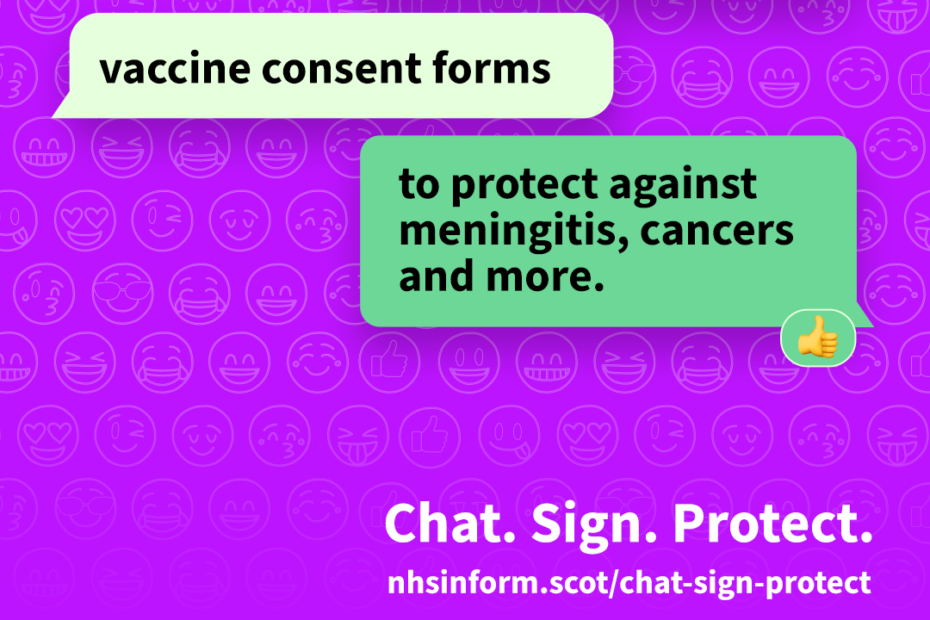
Families are being asked to discuss vaccines with their children, as vaccinations get underway in local secondary schools from this January. Consent forms were distributed to S1 and S3 pupils before the Christmas holidays, so if you have not completed a consent form please check your child’s school bag.
In Scotland, three routine vaccines are offered in secondary schools:
- HPV,
- MenACWY and
- DTP.
They provide young people, their families, and their communities with long-term protection against these serious diseases. If young people don’t get their vaccinations, the risks to themselves and those around them are likely to increase.
All S1 pupils are offered vaccination against Human papillomavirus (HPV), a very common virus that can cause certain cancers including, cervical cancer, head and neck cancers, and anogenital cancers (for example, cancers of the anus, penis, vagina and vulva).
The HPV vaccination programme started in Scotland in 2008, and published studies show that no cervical cancer cases have been detected in fully vaccinated women following HPV immunisation at age 12-13.
Pupils in S3 are offered the MenACWY vaccine to help protect them from meningitis and septicaemia (blood poisoning), as well as the DTP vaccine to protect against diphtheria, tetanus, and polio. Both vaccines complete the childhood vaccination course and provide longer-term immunity.
If your child is out with S1 and S3 and has not had a vaccine course recorded through the Child Health system in previous academic years they too should have had a consent form distributed to the school to complete and return.
NHS Ayrshire & Arran’s Director of Public Health, Lynne McNiven said:
“It is in the whole community’s interest that as many of our young people as possible are protected against vaccine preventable disease. The higher the uptake rate, the better the protection levels.
“Pupils in S1 and S3 have the chance to take an important step to protecting themselves against future health risks – I’d urge families to read the information provided and ensure our young people complete their childhood vaccinations.”
The national Chat. Sign. Protect. campaign is helping to raise awareness of secondary school vaccines. It includes useful information such as videos answering some of the most common questions about secondary school vaccinations, information in other formats and languages, and advice for young people who are not in mainstream school.
The Schools Immunisation Team can be contacted by telephone to assist with any queries relating to school vaccinations – 01294 323466.
ENDS
Background
For more information on childhood vaccinations visit our website: https://www.nhsaaa.net/services/services-a-z/childhood-immunisations/
For more information on Chat. Sign. Protect.: www.nhsinform.scot/chat-sign-protect